Instability Is the New Terrain: How Corporate Treasurers Must Lead When the Fog Never Lifts
The environment facing corporate treasurers has fundamentally changed, not in degree, but in kind. What defined 2025 was uncertainty: a manageable fog of unknowns against which organisations could hedge, scenario-plan, and wait. What defines 2026 is instability: a structural condition in which the very relationships between markets, nations, and financial instruments are in constant motion. Correlations break. Models fail. Political alliances dissolve overnight.
Uncertainty was the wrong word
There is a word that no longer adequately describes what corporate treasurers are navigating. That word is uncertainty. For two years, it served as the organising concept for risk management, for board presentations, for treasury frameworks rebuilt after the twin shocks of the pandemic and the rate cycle. We learned to live with uncertainty, to quantify it, to hedge against its most acute expressions. And in doing so, we inadvertently assumed something that has since proved incorrect: that the fog would eventually lift, that the underlying relationships between variables would hold, and that patience and preparation would eventually be rewarded with a return to navigable conditions.
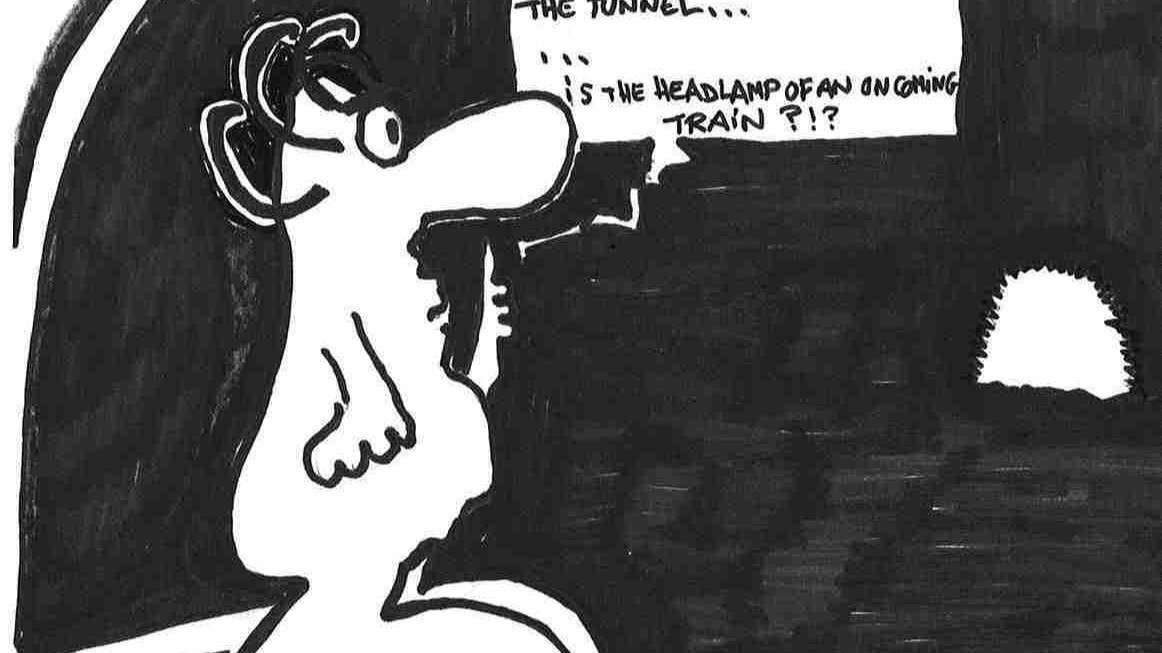
That assumption is no longer tenable. The fog, as I put it at the 8th EACT Summit in La Hulpe, is not something through which we are passing. The fog is the terrain.
The distinction between uncertainty and instability is not semantic. It has direct operational consequences for how treasury functions must be designed, staffed, and governed. Uncertainty is a measurement problem: you know the shape of the risk, even if you cannot precisely quantify it. Instability is a structural problem: the shape itself is changing. When the DXY dollar index — for decades a reliable proxy for global risk sentiment, strengthening as geopolitical stress rose — inverted in 2025 and weakened precisely as tensions escalated, it was not the magnitude of the move that was most significant. It was the signal that a foundational navigational anchor had broken. Treasury teams built their FX risk frameworks around that correlation. It no longer holds.
Four forces dismantling the old playbook
At La Hulpe, I identified four converging forces that together constitute the architecture of today’s instability, and that every corporate treasurer must internalise as operating conditions rather than external background noise.
1. Geopolitical disorder — structural, not episodic. The current US administration has elevated comfort with disorder into a form of strategic leverage — a governing posture that systematically unsettles the multilateral assumptions on which cross-border treasury operations have been built for seventy years. For treasurers managing USD liquidity, cross-border supply chain financing, and correspondent banking relationships, this is not a political observation. It is a treasury risk input that belongs on the risk register.
2. A dollar system being quietly rewired. The de-dollarisation narrative — the story of the dollar losing its reserve currency status — has proven significantly overstated. What is actually occurring is closer to the opposite: a re-dollarisation, driven by dollar-denominated stablecoins explicitly designed to extend the dollar’s digital reach, and by a US administration that has demonstrated a clear willingness to weaponize dollar access as a geopolitical instrument. Treasurers who have built their liquidity frameworks around assumptions of a frictionless dollar system should be revisiting those assumptions.
3. The tokenisation of assets. Not as a fintech curiosity, but as an emerging infrastructure for how value is represented, transferred, and settled. Trade receivables, real-world assets, financial instruments — the process of moving these onto distributed ledger infrastructure is accelerating. The treasurers who understand this technology earliest will have a structural advantage in financing efficiency, settlement risk management, and liquidity deployment. Those who dismiss it as too early will find themselves rebuilding from behind.
4. Artificial intelligence — held with two truths at once. The transformative potential of AI for treasury is genuine: better cash forecasting, AI-assisted scenario modelling, automated FX hedging, real-time risk analytics. But the speculative excess sitting alongside that genuine potential is also real. Private credit markets have grown faster than the risk frameworks designed to monitor them. AI valuations contain components of bubble. The treasurer’s job is to distinguish the durable from the ephemeral — and to build on the former without being swept up in the latter. I keep thinking “Augmented Intelligence” would be a better wording for this powerful technology.
“Volatility is now structural, not cyclical. The appropriate response is not a better forecast — it is a fundamentally different relationship with uncertainty, built into the operating architecture of the treasury function itself.”
— François Masquelier, Chair of EACT
The Brain Economy: treasurers were built for this
Alongside the diagnosis of instability, the 8th EACT Summit opened with an argument that I want to extend here, because it carries implications that go well beyond conference rhetoric. We have entered what economists and technologists are calling the “Brain Economy”: a structural shift in the sources of competitive advantage, away from physical and financial capital and toward cognitive agility, adaptive capacity, and the ability to make sound judgements under conditions of irreducible complexity.
Moore’s Law has made computing power exponentially cheaper. Kryder’s Law has made data storage effectively free. Metcalfe’s Law has made networks increasingly valuable as they scale. The combined effect of these forces is that the scarcest and most valuable resource in the modern economy is not capital, not processing power, and not data. It is the capacity to think clearly under pressure, to adapt rapidly to discontinuous change, and to collaborate effectively across complex, cross-functional, multi-jurisdictional environments.
That description should be recognisable to every corporate treasurer. It is, in essence, a description of what the treasury profession has always demanded of its practitioners. The treasurer who manages a multi-currency cash pool across seventeen jurisdictions, who runs a live IRS portfolio against a floating rate debt book, who negotiates covenant packages with five banking partners simultaneously, who monitors counterparty credit exposure across a derivatives portfolio in real time — that treasurer is already operating as a Brain Economy professional. The rest of the world is now arriving at the recognition that this kind of work is where the value lies.
What the Brain Economy demands from treasury leaders
- Cognitive agility — the capacity to update mental models rapidly when evidence changes, rather than defending positions built on assumptions that no longer hold.
- Cross-functional fluency — the ability to translate financial complexity for non-financial audiences (boards, regulators, operating businesses) without losing precision.
- Technology leadership — not merely using AI tools, but defining how they are deployed, governed, and integrated into risk decision-making frameworks.
- Geopolitical literacy — reading political risk as a treasury variable, not a background condition.
- Community intelligence — leveraging the collective knowledge of peer networks, precisely what forums like the EACT Summit are designed to enable.
Building structural resilience: the three-to-five-year window
Understanding instability is necessary. Responding to it structurally is the harder and more important task. There is a transformation window of three to five years available to treasury leaders who choose to act now. That window is defined not by a deadline but by a competitive dynamic: the organisations that redesign their treasury operating models, invest in the right capabilities, and build genuine structural resilience during this period will define the next generation of treasury excellence. Those that wait for stability to return — for the fog to lift, for correlations to stabilise, for geopolitical conditions to normalise — will find that the window has closed and the gap has widened.
Structural resilience in a treasury context means several things simultaneously. It means liquidity architecture that does not depend on a single corridor, a single currency, or a single set of counterparty assumptions remaining stable. It means risk frameworks that are updated dynamically as conditions change, rather than annually in a governance cycle that was designed for a slower world. It means technology infrastructure that provides real-time visibility rather than batch reporting, and that can be adapted as new tools — AI, tokenisation, digital currencies — move from pilot to production. And it means a team that is genuinely multi-skilled: technically sophisticated, commercially literate, and geopolitically aware.
Europe has a particular role to play in this story, and the EACT community has a particular obligation to advocate for it. The European Union has demonstrated — through IBAN standardisation, through ISO 20022 adoption, through the Verification of Payee framework, through the Digital Business Wallet — that it can set standards that raise global practice. That capacity for intelligent standard-setting is itself a form of structural resilience, a bulwark against the fragmentation that geopolitical instability tends to produce. It is worth defending, and worth fighting for, in the regulatory battles that lie ahead.
“Staying off the digital rails is no longer a conservative choice. In an unstable world, it is becoming strategically dangerous — the equivalent of navigating without instruments in deteriorating weather.”
— François Masquelier, CEO of Simply Treasury
The community as a stabilising force
I want to close with the observation that underpinned the final minutes of this opening address, because I believe it contains the most important practical insight of all. In a world of instability, the community of professional treasurers is itself a stabilising force. Not in spite of the complexity it operates in, but because of it. The treasurer sits at the interface between capital markets and the real economy, managing the liquidity that keeps organisations alive and the risk frameworks that prevent local crises from cascading into systemic ones. That is not a narrow functional responsibility. It is a genuinely significant social and economic function — and it is performed better, significantly better, when it is performed collectively.
The insights shared at a two-day Summit travel back to treasury functions across Europe and beyond, raising the quality of risk thinking, widening the aperture of what practitioners see as possible, and creating the peer accountability that drives genuine professional development. In a world where the fog is the terrain, the map is drawn collectively — one conversation, one shared observation, one rigorously tested assumption at a time.
Instability is not a temporary condition to be managed until things return to normal. It is the new normal, and the treasury profession — by its nature, by its competencies, and by its position in the financial architecture — is better placed than any other function in the organisation to lead the response. That is not a comforting platitude. It is a professional obligation. And the question for every treasurer reading this is not whether instability will demand more of us. It will. The question is whether we are building, right now, the function that is capable of meeting that demand.
References & sources
- F. Masquelier / EACT — Opening Address, 8th EACT Summit, La Hulpe, Belgium (speech script), April 2026
- BIS / FSB — Global Financial Stability Report: Correlation Breakdown and Systemic Risk Signals, 2026
- Mario Draghi — The Future of European Competitiveness: A Report to the European Commission, 2024
- Jensen Huang (NVIDIA) — GTC 2025 Keynote: AI Euphoria, Private Credit, and Systemic Risk Observations, 2025
- IMF — World Economic Outlook: Fragmentation, Geopolitical Risk, and the Dollar System, 2026
- McKinsey Global Institute — The Brain Economy: Cognitive Capital as Competitive Advantage, 2025
- Eurofound / EACT — European Treasury Survey: Risk Frameworks and Geopolitical Adaptation, 2025
- European Commission — Von der Leyen II: Competitiveness, Single Market Deepening, and AI Governance, 2025–26
François Masquelier — CEO of Simply Treasury · Chairman of ATEL · Chair of EACT
© Simply Treasury 2026