Lost in the Vendor Jungle: Why Selecting Treasury Technology Remains One of Finance's Hardest Problems, and How to Finally Crack It
Choosing a treasury management system is one of the most complex decisions a treasurer faces. The market is fragmented, opaque and constantly shifting, with no standard taxonomy or independent rating tool. Yet the stakes are multi-year and multi-million-euro.
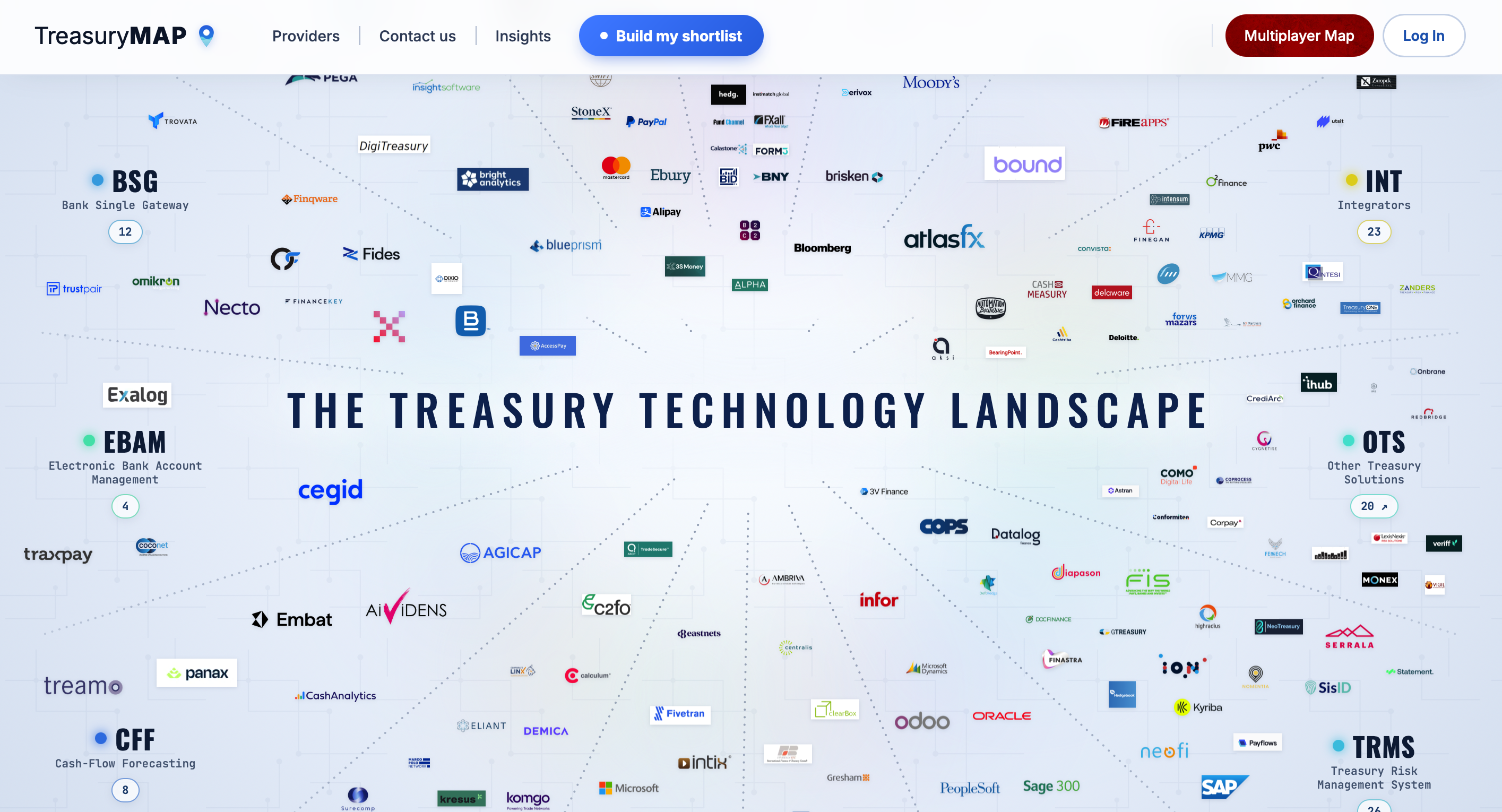
1. The Jungle Is Real, and Growing
The corporate treasury technology market now encompasses well over 250 vendors across a dozen functional categories: treasury management systems (TMS), payment factories, cash visibility platforms, FX and risk engines, in-house banking solutions, bank connectivity middleware, working capital tools, short-term investment platforms, and an emerging wave of AI-powered analytics layers. Each category contains between five and thirty credible vendors, each with its own pricing model, implementation philosophy, integration architecture, and target client profile. The result is a combinatorial explosion. A mid-sized multinational treasurer starting a technology review faces, realistically, a universe of 30 to 60 plausible vendors before a single demonstration has been requested. Most of these vendors have polished marketing websites, impressive client lists (which they share selectively), and sales teams trained to sound identical to one another. Differentiating between them is not merely difficult — it is structurally designed to be so.
KEY INSIGHT
"The problem is not that there are too few treasury technology vendors. The problem is that there is too little independent, structured, and freely accessible intelligence about them." (Francois Masquelier, Chair of EACT)
2. Why the Quest Is So Hard: Six Structural Reasons
2.1 The Taxonomy Problem
There is no universally agreed definition of what a TMS is versus a treasury workstation versus a treasury module of an ERP. Vendors self-classify opportunistically. A payment hub vendor may claim TMS capabilities. A cash management platform may market itself as a full treasury suite. Without a neutral taxonomy, comparing solutions is like comparing supermarkets and delicatessens because both sell cheese.
2.2 The Information Asymmetry Problem
Vendors know their products infinitely better than any buyer can. They control the narrative, manage the reference client list, and design demonstrations to showcase strengths while obscuring weaknesses. Gartner Magic Quadrant and Forrester Wave reports offer some structure, but they cover only the largest TMS vendors and are based on vendor-submitted data and paid analyst relationships. The mid-market and specialist solution space is essentially uncharted.
2.3 The "No Free Lunch" Problem
Independent treasury technology advisory is expensive. Boutique consultancies that truly understand the vendor landscape charge fees that are out of reach for smaller treasury teams. Peer networks help, but suffer from sample bias: your peers have implemented what they implemented, not necessarily what is best for your configuration. And in 2026, there is still no comprehensive, freely accessible, independent tool that allows treasurers to search, filter, compare, and evaluate treasury technology vendors across all categories with neutral scoring.
2.4 The Moving Target Problem
The vendor landscape changes faster than any RFP process. Mergers and acquisitions are frequent: ION Group, FIS, Kyriba, and Coupa have each absorbed multiple competitors in recent years. A vendor that was best-in-class for cash pooling three years ago may have been de-prioritised following a parent acquisition. Cloud migration journeys are at different stages. API maturity varies wildly. The product you evaluate in May may not be the product you go live with in eighteen months. Furthermore, the RFP processes are manual and exhausting for treasury teams, with the terrible risk of missing one top solution in the RFP, what we call the “FOMOTT” (i.e. “Fear of Missing Out a good Treasury Tool”).
2.5 The Organisational Complexity Problem
Treasury technology decisions are rarely made by the treasury team alone. IT, procurement, legal, finance, and often the CFO's office all have a seat at the table — and different, sometimes conflicting, evaluation criteria. IT may prioritise ERP compatibility. Procurement may prioritise total cost of ownership. Treasury may prioritise functional depth. Navigating these competing stakeholder demands while maintaining a coherent evaluation methodology requires significant internal governance discipline.
2.6 The Scope Creep Problem
What begins as a search for a cash visibility tool rapidly expands into a debate about whether to replace the TMS, consolidate bank connectivity, or redesign the payment factory. Without strict scope discipline upfront, the selection process becomes an indefinite digital transformation programme — and never reaches a decision. We should also add the CIO orthodoxy and strategy that is often incompatible with the best interest of treasury management. CIO’s forget that the end-users remain the ones who must choose their “vehicle” for managing treasury well.
3. Enter TreasuryMap.com, A Navigator in the Fog
Against this backdrop of opacity and fragmentation, the emergence of dedicated treasury technology mapping platforms represents a meaningful step forward. TreasuryMap.com is one such initiative: a structured, searchable vendor database covering the principal categories of corporate treasury technology, designed specifically to give treasurers a starting-point for market orientation. The platform's value proposition is directional intelligence rather than definitive scoring. It allows a treasurer to ask structured questions: Which vendors operate in my segment (by company size, geography, and ERP environment)? Which solutions support my specific functional requirements (multi-entity cash pooling, POBO, SWIFT connectivity, EMIR reporting)? Which providers have a demonstrable footprint in the Benelux or the Nordics? This kind of structured filtering — even without deep vendor scoring — dramatically compresses the long-listing phase from weeks of unstructured internet research to hours of targeted investigation.
PRACTICAL NOTE
“TreasuryMap.com does not replace the RFP, the demo, or the reference check. It replaces the blank page. And for a treasurer beginning a selection process, the blank page is the most dangerous place to start”. (Francois Masquelier, CEO of Simply Treasury)
That said, it must be stated clearly: no free tool — TreasuryMap.com included — can yet provide the depth of independent, weighted, continuously updated vendor assessment that a full advisory engagement would deliver. The market needs more: open-access, peer-validated, granular scoring across implementation quality, support responsiveness, total cost of ownership, and roadmap credibility. Until that infrastructure exists, treasurers must triangulate intelligently across multiple intelligence sources.
4. How to Build a Serious Long List
The long list is the foundation of any credible selection process. A poorly constructed long list — too narrow, too vendor-driven, or based on brand recognition alone — corrupts every subsequent step. Here is how to build one that is structurally sound.
- Define scope before vendors. Before opening any vendor website, document in writing the functional perimeter (which treasury activities the tool must cover), the technical constraints (ERP landscape, connectivity standards, cloud vs. on-premise), the organisational scope (number of entities, geographies, currencies), and the non-negotiable requirements (regulatory reporting, bank-agnostic connectivity, multi-currency). This scoping document is the filter through which every vendor must pass.
- Use structured databases, not Google. Platforms like TreasuryMap.com, Gartner Peer Insights, and the EACT vendor survey data provide structured starting-points that are categorised by function and segment. Supplement with the annual surveys published by the ACT, EACT, and NeuGroup, which aggregate peer usage data across large populations of corporate treasurers.
- Mine peer networks deliberately. Your ATEL, EACT, or ACT (i.e. national and international treasury associations) network contains hundreds of treasurers who have recently completed selections. Ask specific questions: not "what TMS do you use?" but "which vendors did you evaluate for your specific configuration, and which did you eliminate and why?" The elimination rationale is more valuable than the final choice.
- Include emerging challengers. Established brand names provide comfort, not necessarily fit. The long list should include two or three emerging vendors that meet your functional criteria, even if their brand recognition is lower. Challenger solutions often offer superior implementation agility and more responsive support at comparable total cost.
- Cap the long list at 8 to 12 vendors. A long list of 20 vendors is not a long list — it is an unmanaged universe. Apply your scoping criteria rigorously and reduce to a manageable field before issuing any RFI.
5. How to Shortlist with Discipline and Confidence
The shortlist is where many treasury selection processes break down. Subjective impressions from demonstrations, vendor relationship pressure, and internal political dynamics contaminate what should be a structured, evidence-based comparative assessment. Here is the antidote.
- Issue a structured RFI before any demo. A well-designed Request for Information forces vendors to respond on your terms, not theirs. Include mandatory questions on implementation methodology, SLA commitments, client attrition rates, regulatory roadmap, total cost of ownership over five years, and reference clients in your industry and geography. Vendors who decline to answer specific questions are signalling something worth noting.
- Build a weighted scoring matrix. Define your evaluation criteria and assign explicit weights before any vendor engagement begins. Typical categories: functional fit (30%), technical architecture and integration (20%), implementation quality and timeline (15%), total cost of ownership (20%), vendor stability and roadmap (10%), references and peer validation (5%). Adjust weights to your organisation's priorities — but set them before, not after, you have seen the demos.
- Standardise the demonstration agenda. Every vendor on your shortlist must demonstrate the same three to five scenarios, drawn from your actual treasury operations. A demonstration that follows the vendor's preferred script reveals marketing capability, not solution fit. Your scenarios should test the edge cases: multi-entity netting, exception management, regulatory reporting under EMIR, or whatever is genuinely complex in your environment.
- Conduct independent reference checks. Do not rely solely on vendor-provided references. Use your peer network, EACT connections, and platforms like Gartner Peer Insights to identify clients who are not on the vendor's preferred list. Ask references specifically about post-implementation support quality, upgrade experience, and whether they would choose the same vendor again today.
- Stress-test the total cost of ownership. Licensing fees are the visible tip of the iceberg. Implementation fees, integration development, annual maintenance, training, upgrade costs, and the internal resource cost of the project typically represent two to four times the licence cost over a five-year horizon. Require vendors to provide a detailed five-year TCO model and hold them contractually to key assumptions.
DISCIPLINE RULE
“The shortlist decision should never be a consensus of impressions. It should be the output of a weighted scoring matrix, completed independently by each member of the evaluation team, before the group discussion begins”. (Francois Masquelier – Chair of EACT)
6. The Market Needs Better Infrastructure, A Call to Action
The treasury profession deserves better than the current state of technology intelligence. What is needed is a freely accessible, continuously updated, independently curated, peer-validated database of treasury technology vendors — covering all segments, all geographies, and all functional categories — with transparent scoring methodology. Initiatives like TreasuryMap.com are moving in the right direction. Associations such as EACT, ATEL, and the ACT could accelerate this by pooling anonymised RFP and selection data from member treasurers to create a genuine, crowd-sourced intelligence layer. Until that infrastructure matures, the practical prescription is clear: be disciplined about scope, be rigorous about process, use every available structured source, and never mistake a compelling demonstration for a proven solution. The vendors who win the demo are not always the vendors who survive the implementation.
"In treasury technology selection, the quality of your question determines the quality of your answer. Ask better questions — of the vendors, of your peers, and of yourself."
— François Masquelier, Simply Treasury
Simply Treasury | François Masquelier | Luxembourg, May 2026 | www.simplytresury.com
© 2026 Simply Treasury. All rights reserved. This article is for informational purposes only and does not constitute financial or