The ATEL Treasury Compass 2026: Best Practices, Trends & Innovation in Corporate Treasury
ATEL's annual reference guide for corporate treasurers, anchored in the EACT 2026 Treasury Survey (N=283) and enriched by Simply Treasury analysis. Eleven interconnected themes, from cash-flow forecasting and working capital to tokenisation, payment security and short-term cash investment, plus five imperatives for European treasury leaders.
Published annually by ATEL (Association des Trésoriers d'Entreprise au Luxembourg), with practitioner analysis under the Simply Treasury brand. Anchored in the EACT 2026 Annual Treasury Survey (N=283).
⬇ Download the ATEL Treasury Compass 2026 (PDF)
The ATEL Treasury Compass is the annual reference guide for corporate treasury professionals in Luxembourg and across the European corporate landscape. Its purpose is threefold: translate the latest survey data into actionable practitioner guidance, synthesise the year's most significant regulatory, technological and market developments, and give treasury functions the strategic context to benchmark their priorities, identify gaps and calibrate their transformation agenda. The 2026 edition is built around eleven interconnected themes, each grounded in the EACT 2026 survey and enriched by original analysis.
The eleven themes of the 2026 edition
- EACT Survey 2026, key findings. Cash-flow forecasting remains the number one priority for the seventh year running; TMS shortfalls (management reporting, long-term forecasting, risk reporting, stress testing) still force manual workarounds; ISO 20022 tops the regulatory radar (61.3%), ahead of ESG reporting (45.1%).
- Working capital optimisation. The 4th priority, yet 72.6% of treasurers still rely on payment terms as their only lever. The instruments exist (supply chain finance, e-invoicing, Request-to-Pay); what is missing is CFO sponsorship and cross-functional KPI alignment.
- Treasury centralisation: IHB vs Payment Factory. Two different animals often confused. An in-house bank is a legal/functional structure replicating bank services for subsidiaries; a payment factory is an operational architecture that centralises and standardises payment processing. 67% of corporates above $10bn run an IHB, and payment-factory adoption is now democratising into the mid-market.
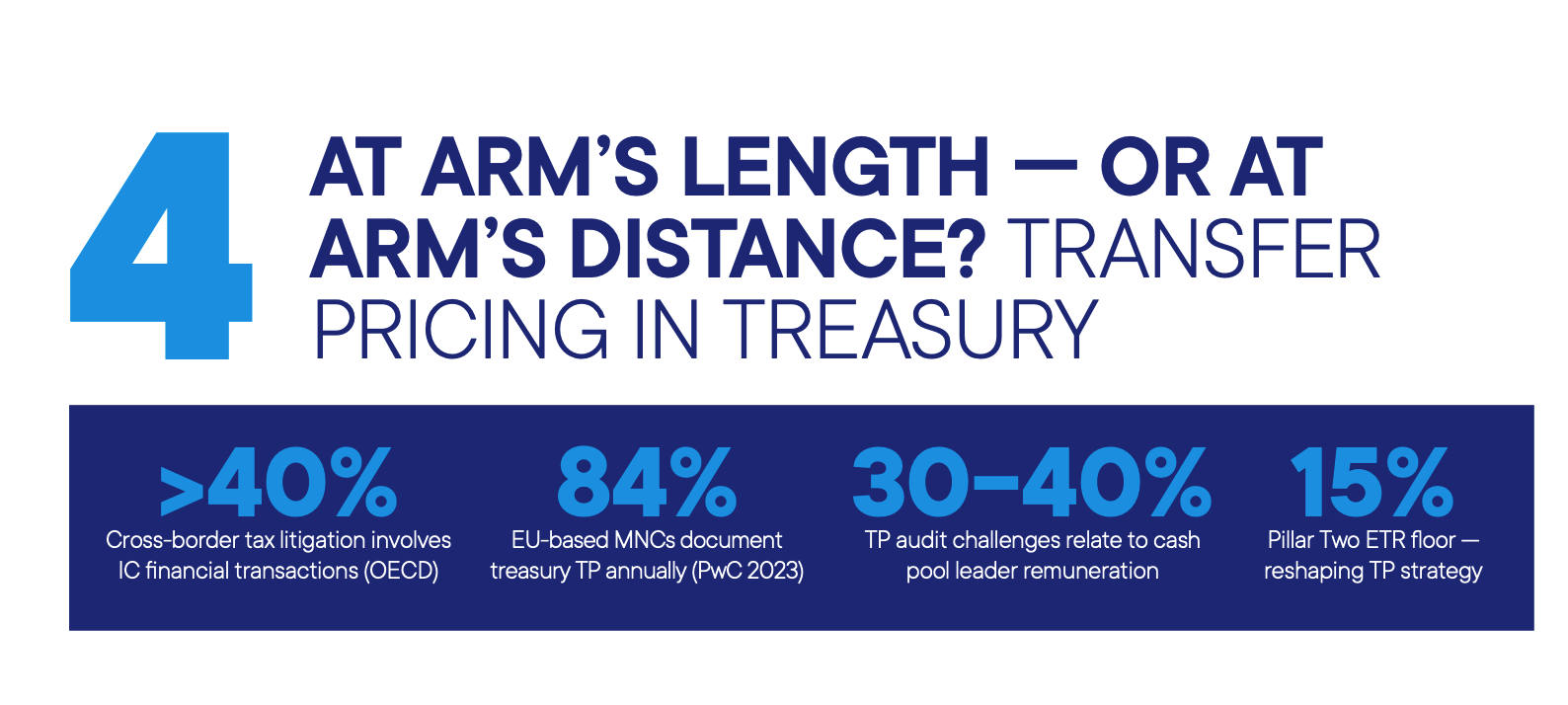
- Transfer pricing in treasury. Intercompany financial transactions are the single largest category of cross-border tax litigation, and Pillar Two raises the stakes: a defensible TP position can still trigger top-up taxes. Treasury and tax must work from a shared model.
- KPI / KRI / KVI framework. A structured approach to treasury governance and board reporting, with AI-assisted tooling changing the economics of producing indicators that once took hours of manual assembly.
- Payment security, from KYC to KYP. Verification of Payee (VoP) is a necessary base layer but not sufficient: it validates ownership, not context; it is domestic and fragmented; and it returns ambiguous responses. It must sit alongside clean vendor master data, segregation of duties and behaviour-scoring AI.
- Tokenisation & programmable payments. Low adoption, high intent. The value is not speculative assets but tokenised deposits, programmable payments and real-time collateral. Production is already here (a €300m digital bond settling end to end in minutes).
- Uncertainty as the new benchmark. Volatility is now the operating environment, not the exception. The adaptive, AI-enabled treasury moves from guardian of liquidity to orchestrator of financial data, risk and technology, with Europe's standards-setting position (IBAN, ISO 20022, Instant Payments) as a competitive advantage.
- Hedge accounting automation. A persistent TMS gap in FX risk management, and a candidate for automation.
- Short-term investment of excess cash. Segment cash by purpose (operating, core, strategic), then match each tranche to instruments by horizon and liquidity. Money market funds remain the benchmark, with caveats; the Credit Suisse weekend was a reminder that no bank is too big to fail fast.
- Expert interviews. Industry voices on liquidity, tokenised MMFs and the digital-asset gateway for corporate treasurers.
Conclusion: the imperatives for European treasury leaders
- Close the forecasting gap with AI, not spreadsheets. Seven years at number one is a structural indictment of how treasury data is collected and governed. The technology is available; the decision to invest is the only remaining barrier.
- Treat working capital as a business programme, not a treasury project. Embed DSO, DPO and CCC into Sales, Procurement and Shared Services performance frameworks, or accept that treasury stays the only function accountable for a company-wide problem.
- Build your governance infrastructure before the auditors arrive. With transfer-pricing disputes now over 40% of cross-border tax litigation and Pillar Two raising the stakes, contemporaneous documentation and TMS-based audit trails let you manage auditors from strength.
- Embed real-time into every layer of the operating model. Real-time data, connectivity and controls become the default, not the exception.
- Design the function to profit from volatility. As François Masquelier puts it, the treasurer who waits for normality will wait indefinitely; the one who designs their function to profit from volatility will define the profession's next chapter.
“Uncertainty is not the exception, it is now the operating environment. The treasurer who designs their function to profit from volatility will define the profession's next chapter.”
François Masquelier, Chairman of ATEL, Chair of EACT, CEO of Simply Treasury